


Siemens Bets Big on U.S. Manufacturing to Meet Surging AI Data Centre Demand
The expansion of AI workloads is creating massive demand for physical infrastructure — and the companies that build electrical systems are scaling up to meet it. Siemens recently announced more than $165 million in new manufacturing investments across North and South Carolina, adding facilities and hundreds of jobs specifically aimed at producing the electrical equipment that powers data centres and AI factories.
The investment is a clear signal of where the infrastructure bottleneck sits right now. While much of the AI conversation focuses on chips, models, and software, the physical layer — power distribution, switchgear, busway systems, and prefabricated electrical assemblies — is where capacity constraints are increasingly felt. Data centres consume enormous amounts of electricity, and the equipment needed to deliver, manage, and protect that power supply has to be manufactured, assembled, and installed before any server rack goes live.
What Siemens is building
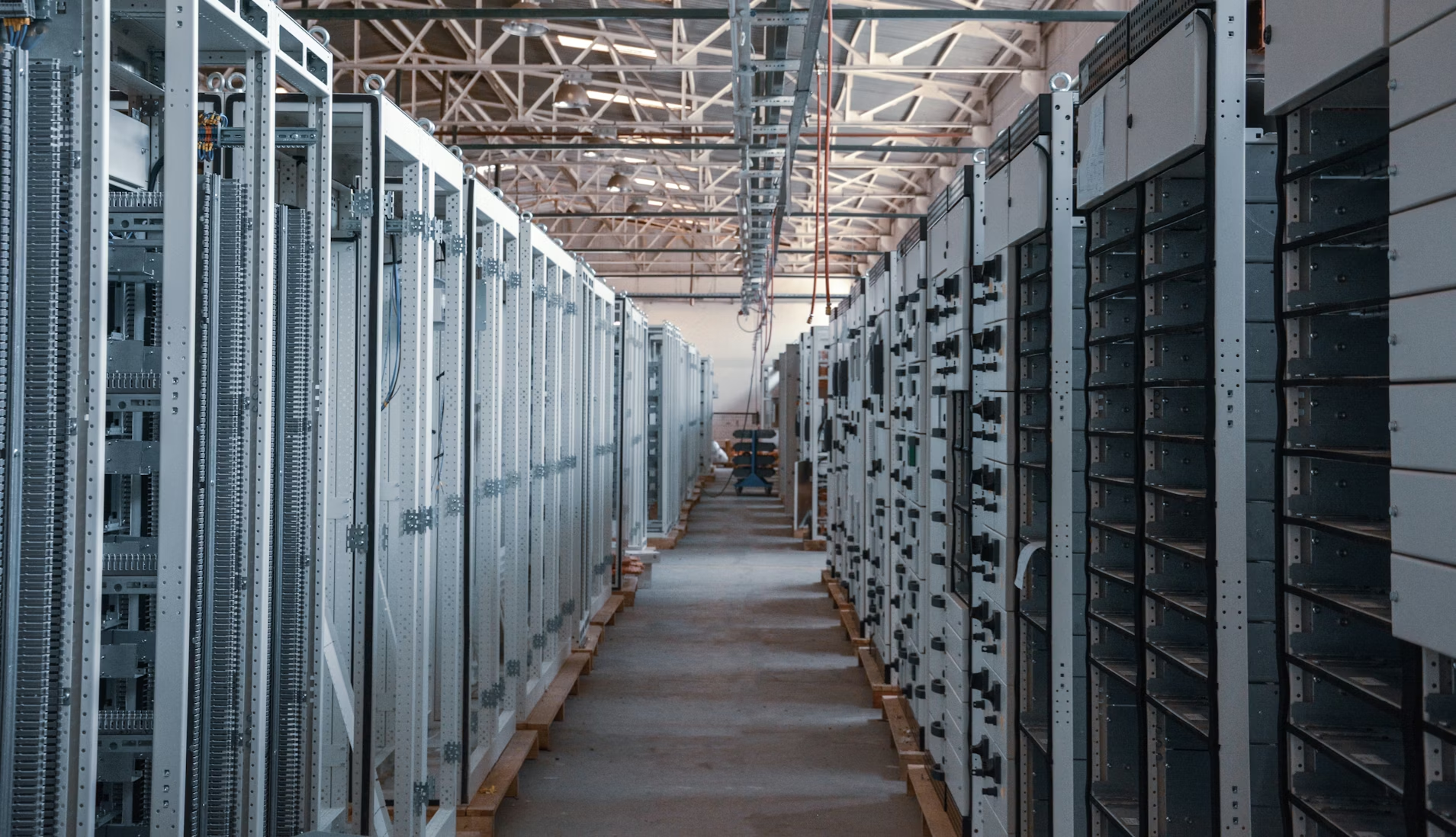
The Carolina investments include multiple new and expanded facilities. In Raleigh, North Carolina, a new 131,000 square foot facility will assemble integrated power delivery solutions — prefabricated systems designed to reduce on-site installation time for data centre operators. In Wendell, also in North Carolina, a new site will localise production of medium voltage protection and automation devices, while an existing facility expands switchgear production capacity.
In South Carolina, a new facility in Spartanburg will handle lighting panel production and distribution, while an expanded site in nearby Roebuck increases busway manufacturing capacity with new paint, epoxy, and plating lines. Across both states, the investments are expected to create around 350 new manufacturing jobs.
These projects add to nearly $700 million Siemens has committed in recent years to expanding U.S. electrical manufacturing capacity, including facilities in California and Texas.
Why electrical infrastructure is the AI bottleneck
The narrative around AI infrastructure tends to focus on semiconductor supply and GPU availability. But the physical systems that deliver power to those chips are just as critical — and in many cases harder to scale quickly. A data centre is ultimately an electrical facility. Every rack of GPUs requires reliable power delivery from the grid through multiple layers of transformation, distribution, switching, and protection equipment.
As AI workloads grow more power-intensive — with individual training clusters now consuming tens of megawatts — the demand for electrical infrastructure is scaling in parallel. Prefabricated and modular power delivery systems, like those Siemens is producing in its new Raleigh facility, are becoming increasingly important because they allow data centre operators to bring capacity online faster than traditional site-built approaches.
Siemens positions its data centre and AI infrastructure portfolio as a chip-to-grid solution — covering simulation, automation, cooling optimisation, and electrical distribution as an integrated stack rather than a collection of individual components.
The workforce dimension
Manufacturing capacity alone does not solve the problem if there are not enough skilled workers to operate the facilities and install the equipment. Siemens is addressing this through a workforce development initiative called Careers Electric, launched in North Carolina with a $9.25 million investment from the Siemens Foundation. The programme is designed to expand access to electrical training and create pathways into manufacturing and installation careers — roles that are essential to actually delivering the infrastructure that AI depends on.
What this signals for the broader market
Siemens is not the only company scaling up electrical manufacturing for data centres, but the size and specificity of these investments reflect how confident major industrial players are that AI-driven power demand is not a short-term cycle. The company reported record levels of data centre-related electrical equipment orders, and these new facilities are a direct response to that demand.
For the smart infrastructure sector more broadly, the pattern is clear: AI is not just a software story. It is an industrial story — one that runs through power grids, manufacturing plants, and the physical systems that keep data centres operational. The companies that can build and deliver that infrastructure at speed will capture a significant share of the value being created by the AI buildout.
Around 620 words. Category: Smart Infrastructure. The Siemens link is embedded naturally in the middle of the post as a contextual reference to their data centre portfolio. Want me to draft the next two posts?